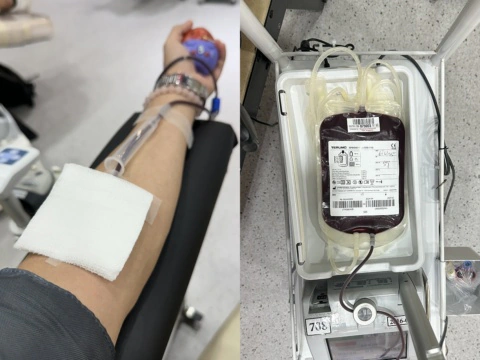
Considering blood donation but unsure where to begin? This guide breaks down the process and what donors can expect.
Blood donation plays a critical role in the healthcare system. In Singapore, around 15 units of blood are used every hour, and the Health Sciences Authority needs to collect about 400 units of blood each day to meet patient demand.
Table of Contents
Blood Donation in Singapore: Overview
Who can donate? Anyone in generally good health, aged 16-75, and weighing at least 45 kg.
Where to donate? Blood donations can be made at any of Singapore’s five blood banks, conveniently located near MRT stations, or at mobile blood donation drives.
What happens during donation? A brief health assessment, 5–10 minutes of blood collection, followed by about 10 minutes of rest before you are cleared to leave.
Is it safe? Yes. Strict hygiene protocols are observed, and all blood collection equipment is new, sterile, and single-use.
Is it worth doing? Absolutely – one unit of blood can save up to three lives!
Benefits of Donating Blood
For many patients, donated blood is essential. It supports emergency care, major surgeries, and the ongoing treatment of conditions such as leukaemia, thalassaemia, and bleeding disorders. A single unit of blood can potentially help up to three patients, depending on how it is processed and used.
Blood donation in Singapore is voluntary and non-remunerative, making it a practical way to support the healthcare system and patients in need.
Eligibility and Requirements
- Be in generally good health.
- Have no symptoms of infection (such as sore throat, cough, runny nose, or diarrhoea) for at least one week.
- Have had no fever in the past four weeks.
- Have not taken antibiotics in the last seven days. If you have, wait at least one week after your final dose.
- Be at least 16 years old. Donors under 18 must provide a signed parental consent form.
- Weigh at least 45 kg.
- Meet the minimum haemoglobin level: 13.0 g/dL for males and 12.5 g/dL for females.
- Have not travelled overseas in the past four months to regions with travel-related infection risks. Refer to HSA’s Travel Overseas (A-Z list) and the section on donating blood after overseas travel.
Important: Do not discontinue or stop taking any medication prescribed or recommended by your doctor in order to donate blood.
Get ready for blood donation
In the weeks leading up to your donation, build healthy iron levels by eating iron-rich foods such as spinach and raisins. As your donation day approaches, keep these simple preparation tips in mind:
– Drink plenty of water the day before your donation.
– Get adequate rest the night before.
– Eat regular meals on the day of donation. Aim to have a light meal or snack about three hours before donating.
– Wear comfortable clothing, with sleeves that can be easily rolled up above the elbow.
Blood Donation Process: Step-by-Step
- Check your eligibility. Review the requirements to make sure you are eligible to donate.
- Complete the additional eligibility check. First-time donors will need to answer additional screening questions on the HSA website before proceeding.
- Book an appointment. Make an online appointment via the DonateBlood mobile app (iOS | Android) or the web portal. A SingPass login is required. You may also complete the Donor Health Assessment Questionnaire and Declaration Form online to save time at the blood bank.
- Do the final health screening. On the day of your appointment at the blood bank, you will undergo a final health assessment, including a haemoglobin level test, before donation.
- Donate blood. Once cleared, you will be guided to a donation chair. Your arm will be cleaned, and a local anaesthetic will be applied before the needle is inserted. The blood draw itself takes 5–10 minutes, while the full visit typically lasts 45 minutes to an hour, including registration and recovery.
- Rest and recover. After donating, rest for at least 10 minutes. Snacks and drinks are provided to help you recover. You may leave if you feel well.
- Post-donation recovery. The plasma portion of your donated blood is naturally replaced within a few days. Iron supplements may be offered to support recovery, but they are optional.
What do I need to bring?
On your visit to the blood bank, please bring the following:
– A valid photo ID, such as your NRIC, work pass, or passport.
– Parental or guardian consent if you are under 18 (the online consent form must be completed in advance).
– A list of any medications you are currently taking, to be reviewed by the medical staff.
Where to Donate Blood in Singapore
Singapore has five blood banks, all conveniently located near MRT stations, as well as mobile donation drives. Choose the location that is most convenient for you.
1. Bloodbank@HSA
Health Sciences Authority
(Opposite Outram Park MRT Station)
11 Outram Road
Singapore 169078
2. Bloodbank@DhobyGhaut
Dhoby Ghaut MRT Station
Dhoby Xchange (Near Exit B)
11 Orchard Road
#B1-01 to #B1-09
Singapore 238826
3. Bloodbank@Woodlands
Woodlands Civic Centre
(Opposite Causeway Point)
900 South Woodlands Drive
#05-07
Singapore 730900
4. Bloodbank@WestgateTower
Westgate Tower
(Linked to Jurong East MRT Station)
1 Gateway Drive
#10-01 to 05
Singapore 608531
5. Bloodbank@One Punggol
One Punggol
1 Punggol Drive,
#02-38
Singapore 828629
Post-donation Care
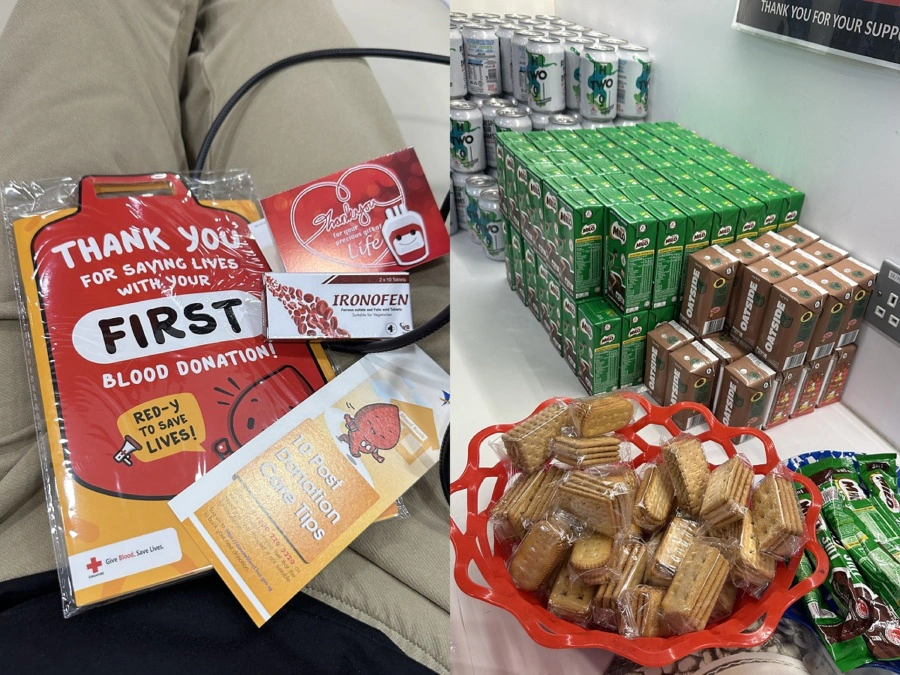
(L) Some post-blood donation essentials. (R) Snacks and drinks offered to donors after donating. Photo: Lord Acuña
To support recovery after blood donation, follow these simple guidelines:
Do:
✅ Keep the bandage on for at least 4 hours.
✅ Drink plenty of fluids over the next 48 hours to replace lost fluids.
✅ Eat iron-rich foods, and consider taking an iron supplement on alternate days to help replenish iron levels.
Avoid:
❌ Drinking coffee or tea when taking iron supplements, as they reduce iron absorption.
❌ Using the donation arm to carry heavy items for 12 hours, to minimise bruising.
❌ Strenuous activity or prolonged standing for 24 hours, to allow your body to recover.
If you experience severe pain, ongoing numbness, or swelling that keeps getting bigger or feels painful, see a doctor or visit the nearest polyclinic or hospital.
Blood donation: A simple way to make a real impact
My first blood donation experience was smooth and well-organised. The process was efficient, and I did not feel dizzy, weak, or unwell afterwards. If you are eligible, donating blood is a straightforward way to contribute to Singapore’s healthcare system. Read the FAQs below for more details, and book an appointment when you’re ready.
Frequently Asked Questions
Is blood donation safe?
Yes. Blood donation is safe. All staff follow strict hygiene protocols, and all equipment (needles, swabs, tubing, gauze) is new, sterile, and single-use.
What is the minimum age required for blood donation?
The minimum age for whole blood donors is 16 years old. For donors under 18, a parent or guardian must provide a signed consent form.
What is the maximum age required for blood donation?
First-time donors: Up to 65 years old (1 day before their 66th birthday).
Repeat donors: Until 75 years old (1 day before their 76th birthday).
Can foreigners donate blood in Singapore?
Yes. Foreigners may donate blood in Singapore if they are residing in Singapore, holding a valid form of identification (such as a passport, Employment Pass, or Work Permit), and have a local contactable address and phone number.
How long does a blood donation take?
The blood draw itself takes 5–10 minutes, while the entire visit – including registration and recovery – typically lasts 45–60 minutes.
How often can I donate blood?
For whole blood donation, you can donate once every 12 weeks. While for apheresis donation, plasma and platelets can be donated every 4 weeks.
What happens to donated blood?
Donated blood is processed and undergoes a series of laboratory tests before it is released for patient use. This process typically takes about 24 hours.
What if I had a tattoo, skin piercing or acupuncture done in the last 3 months?
– If the procedure used sterile, single-use or disposable needles, you can donate immediately.
– If not, or if you are unsure, you must wait 3 months from the date of the procedure.
Can I donate blood after dental work?
Yes, but you need to wait before donating, depending on the procedure:
- Scaling or dental filling: Wait 1 day.
- Tooth extraction: Wait 3 days.
- Root canal treatment: Wait 7 days.
- Wisdom tooth extraction (single or multiple): Wait 1 month.
What if I have an anxiety disorder, obsessive disorder or depression?
You may be eligible provided:
– You are well and stable on the day of donation.
– There has been no change in medication dose or frequency in the last 6 months (for those on medication).
– You have had no hospital admission exceeding 24 hours in the last 6 months due to the condition.
– You have not stopped treatment or missed follow-ups.
If any of these conditions are not met, a memo from your doctor is required. You must also be able to consent to the donation process and fully understand the questions in the Donor Health Assessment Questionnaire and Declaration Form.
What if I travelled overseas in the last 4 months?
Travel to certain countries may make you temporarily ineligible due to infections that can be transmitted via blood. Check HSA's Travel Overseas (A-Z list) to confirm if you can donate.
What high-risk activities are prohibited before blood donation?
- Casual sex, sex with multiple partners, sex with prostitutes, or sex with someone living with HIV/AIDS
- Sex between men (for male donors)
- Use of injectable or recreational drugs
- Working as a prostitute or commercial sex worker
Note: "Sex" refers to anal, oral, or vaginal contact, regardless of use of condom or any protection.
Discussion
Be the first to comment!